
I've always been captivated by blue. The endless expanse of the sky, the serene depths of the ocean... it feels like blue is a constant in our world. But then, I started noticing something curious: when it comes to actual living creatures and plants, true blue is incredibly hard to come by. It made me stop and ask, 'Why?'
Blue is so rare in nature because true blue pigments are chemically complex and difficult for plants and animals to produce. Unlike reds and yellows, there isn't an easy metabolic pathway to create blue. Therefore, most blue colors seen in nature are 'structural colors,' created by microscopic physical structures that scatter light to reflect only blue wavelengths.
But here's where it gets truly mind-blowing. Knowing what makes blue rare is one thing, but understanding how nature pulls off its blue magic is another entirely. Trust me, the science behind these 'structural colors' is pure genius, a testament to evolution's incredible artistry. I've spent hours marveling at these mechanisms, and I can't wait to share these captivating secrets with you.
This is false. The majority of blue colors in animals are 'structural colors,' created by microscopic surfaces that scatter light to reflect only blue wavelengths.
Ever marvel at a blue morpho butterfly's iridescent wings or a peacock's stunning tail? You might be surprised to learn that vibrant hue isn't from pigment. Animals have mastered a clever trick of physics, bending light itself to appear a brilliant blue.
Animals create blue without pigment through a phenomenon called structural coloration. This involves microscopic structures on their surfaces—like scales, feathers, or skin—that are precisely shaped to interfere with and scatter light waves, reflecting only blue wavelengths back to the observer's eye while absorbing all other colors.
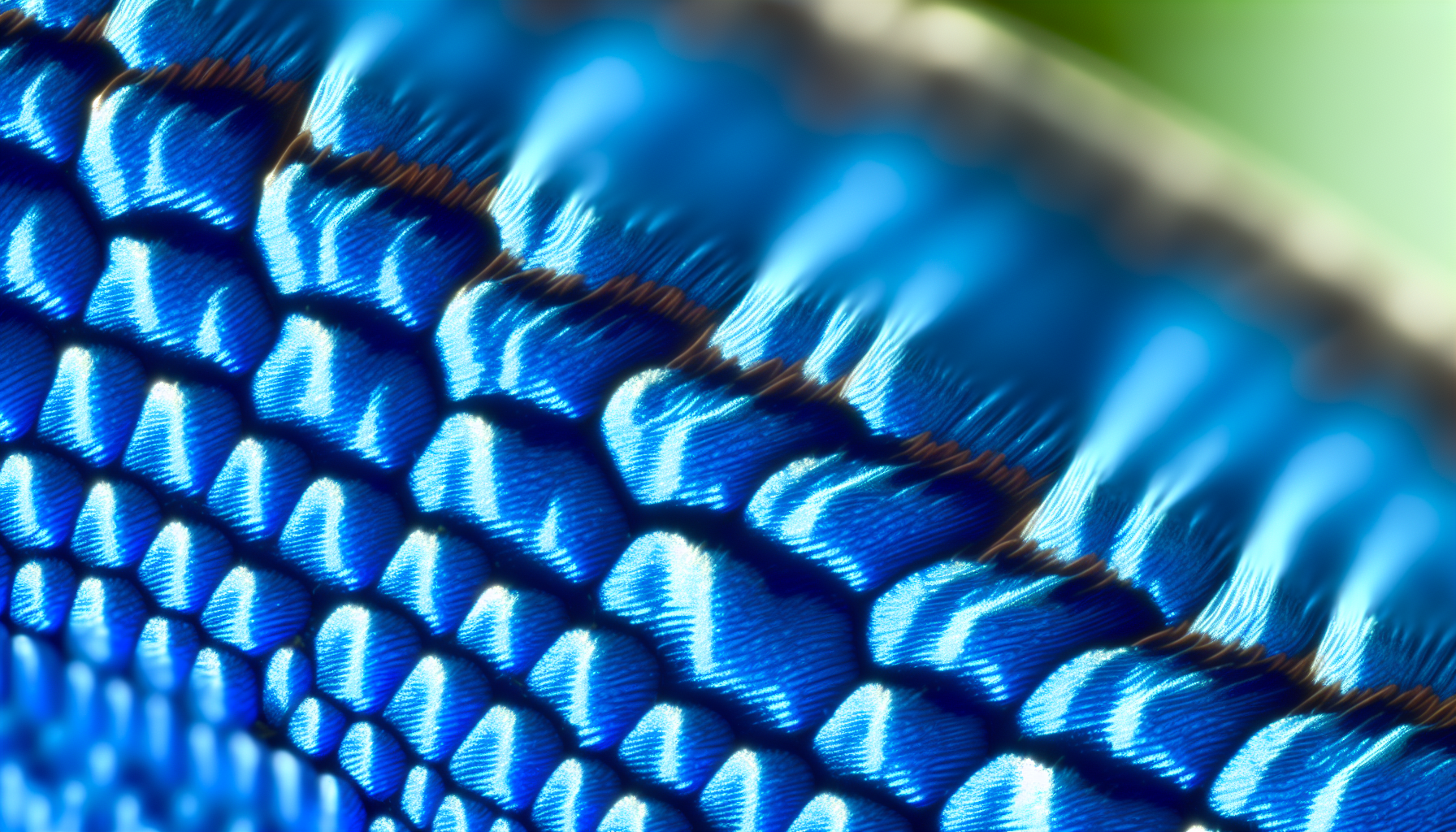
Instead of relying on complex and rare blue molecules, many animals have evolved to use physics to their advantage. This 'structural color' is more durable than pigment, as it doesn't fade over time. It's a testament to the efficiency and ingenuity of natural selection.
At its core, structural color is about manipulating light. The color we perceive depends on which wavelengths of light reach our eyes. While pigments absorb certain wavelengths and reflect others, structural coloration works by physically interfering with light waves. Animals achieve this using incredibly small, precisely arranged structures on the nano-scale.
These nanostructures—which can be tiny pits, layers, or fibers—are spaced in such a way that when white light strikes them, the waves interfere with each other. Blue light waves, which have a shorter wavelength, are reflected and amplified through constructive interference, while longer wavelengths like red and yellow cancel each other out. The result is a pure, often iridescent blue that can shift with the viewing angle.
This amazing trick is found across the animal world, from insects to birds to mammals.
Blue Morpho Butterflies: Perhaps the most famous example, their wings are covered in microscopic scales with ridges shaped like Christmas trees. These layers cause light to diffract and interfere, producing an intense, shimmering blue. The exact hue changes depending on the angle you view it from. You can explore more about the nanostructures in butterfly wings1.
Birds: Many blue birds, like the Blue Jay, Eastern Bluebird, and peacock, get their color from their feathers. Their feathers contain minuscule air pockets within the keratin protein. These pockets scatter incoming light, and because blue light is scattered more effectively than other colors (a phenomenon related to Rayleigh scattering, which also makes the sky blue), the feathers appear blue. An underlying layer of melanin pigment absorbs the other non-reflected colors, making the blue appear even more vibrant. For more details, see this guide on structural color in bird feathers2.
Mammals and Reptiles: Structural color is much rarer in mammals, but a striking example is the mandrill. The vibrant blue on its face and rump comes from precisely arranged collagen fibers in the skin that scatter light. There are no blue pigment cells involved.
Here is a table summarizing these methods:
| Animal | Structure Responsible | Primary Mechanism |
|---|---|---|
| Blue Morpho Butterfly | Layered nanostructures on scales | Coherent Scattering |
| Blue Jay | Air pockets in keratin feathers | Incoherent Scattering |
| Mandrill | Parallel collagen fibers in skin | Coherent Scattering |
Their wings use structural coloration, where microscopic scales scatter light to reflect blue wavelengths, not pigment.
The vibrant blue on its face comes from precisely arranged collagen fibers in the skin that scatter light, not from pigment cells.
While most blues in nature are an illusion of light, a few remarkable organisms have cracked the chemical code. They defy the norm by producing a true blue pigment, offering a rare glimpse into nature's metabolic creativity.
Yes, but they are incredibly rare. The standout example is the Olivewing butterfly (Nessaea aglaura), which produces a true blue pigment called pterobilin. Most other organisms, including plants, create the color through structural means or by chemically modifying other common pigments.

For a long time, scientists believed no animal could produce a true blue pigment. The vast majority of blues we see—from blue jays to morpho butterflies—are structural colors, created by microscopic surfaces that scatter light. However, nature is full of surprises, and a few exceptions have been discovered.
The most definitive example of a true blue pigment in the animal kingdom is found in the Olivewing butterfly (Nessaea aglaura). Unlike its structurally colored counterparts, this butterfly's stunning blue markings come from a pigment called pterobilin. This pigment is a type of bile pigment, chemically related to the bilirubin in our own bodies. The discovery of pterobilin challenged long-held assumptions and highlighted a unique evolutionary pathway to creating color. For those interested in the biochemistry, exploring pterobilin pigment research3 offers a fascinating look into this rare phenomenon.
While the Olivewing is a clear case, other organisms present more complex scenarios.
The plant kingdom's approach to blue is equally fascinating and indirect. No known plant has a true, stable blue pigment. Instead, they perform a kind of chemical alchemy. They use a common class of red and purple pigments called anthocyanins and modify them to appear blue. By altering the pH in their cellular vacuoles or by binding the anthocyanin molecules with metal ions, they can shift the pigment's color from red or purple into the blue spectrum. This is why the color of a hydrangea can change based on soil acidity. Delving into the world of anthocyanins in plants4 reveals the clever chemistry behind blue flowers.
Unlike most animals that use structural color, this butterfly produces pterobilin, a true blue pigment, to create its distinctive markings.
No known plant has a true blue pigment. They modify red and purple anthocyanin pigments to appear blue through chemical changes.
While gardens boast a rainbow of colors, finding a truly blue flower is a rare treat. Ever wonder why nature makes it so difficult for plants to produce this captivating hue? The answer lies in a fascinating intersection of chemistry, genetics, and evolution.
Blue flowers are uncommon primarily because plants lack a true genetic pathway to produce blue pigment. Instead, they must create the color indirectly by modifying red anthocyanin pigments through complex processes involving pH shifts, co-pigmentation, and metal ion interactions, making it an evolutionarily difficult trait to achieve.

The scarcity of blue in the floral world is a direct result of botanical biochemistry. Unlike carotenoids which produce vibrant reds, oranges, and yellows, there is no simple, direct metabolic pathway for a true blue pigment in plants.
Most flowers that appear blue are actually performing a clever chemical trick. They use a group of pigments called anthocyanins, which are naturally red, purple, or pink. To achieve a blue hue, plants must alter the chemical environment around these pigments. This process of modifying red anthocyanin pigments5 is incredibly complex. It often involves 'co-pigmentation,' where other colorless molecules stack onto the anthocyanin pigments, shielding them and shifting their perceived color towards blue.
Another critical factor is the pH level within the plant's petal cells. For example, the Japanese morning glory can change its petal color from purple to blue as the flower opens by increasing the pH in its cells. Furthermore, metal ions like iron or aluminum can form complexes with anthocyanins, which stabilizes the pigment and produces a blue color. This is famously seen in hydrangeas, whose color is directly influenced by the aluminum content and pH of the soil.
While less common, some plants have abandoned pigments altogether and opted for physics. Similar to peacock feathers, some flowers create blue through microscopic structures on their petal surfaces that scatter light. These nanostructures interfere with light waves, reflecting only blue light back to the observer. This phenomenon of structural color in plants6 is a remarkable example of convergent evolution, achieving the same result through entirely different means.
Plants lack a true blue pigment. They create blue by modifying red anthocyanin pigments through complex chemical processes like pH shifts and metal ion interactions.
Yes, hydrangeas famously change color based on the soil's pH, which affects their ability to absorb aluminum ions that interact with pigments.
The recipe for blue is one of nature's most guarded secrets. Unlike the simple chemistry behind reds and yellows, creating a true blue pigment requires a molecular structure so complex and energetically costly that most organisms simply don't bother.
Producing blue pigments is difficult for nature due to the complex molecular structures and high energy required. A molecule must absorb yellow and orange light to appear blue, which necessitates a specific arrangement of atoms and electrons that is metabolically expensive and evolutionarily challenging to develop and maintain.

The challenge of producing blue pigments is rooted in fundamental principles of chemistry and physics. For an object to appear blue, its surface must absorb the complementary colors on the light spectrum—namely, yellow and orange light—while reflecting blue light back to the observer.
Molecules get their color from chemical structures called chromophores, which absorb specific wavelengths of light. The energy from the absorbed light excites electrons within the molecule, moving them to a higher energy state. To absorb yellow/orange light, a molecule needs a very particular and complex structure, often involving large, conjugated systems of double bonds or the coordination of metal ions. These intricate structures are not easy to assemble biochemically.
Creating these complex molecules is an energetically expensive process for an organism. It requires a long and specialized metabolic pathway to synthesize them. Furthermore, blue pigment molecules are often less stable than other pigments. For example, anthocyanins, the pigments that can make flowers blue, are highly sensitive to pH changes. In an acidic environment, they appear red, and they only become blue in alkaline conditions, often requiring the presence of metal ions to stabilize the blue hue. This intricate balancing act is hard to maintain. Compared to the relatively straightforward production of chlorophylls and carotenoids7, which are essential for photosynthesis and protection, investing cellular energy into a fragile blue pigment offers a much lower evolutionary return for most species.
The text states that producing blue pigments is energetically costly due to the complex molecular structures required, which are metabolically expensive for organisms to synthesize.
For an object to look blue, its surface must absorb the complementary colors on the light spectrum, which are yellow and orange, while reflecting blue light.
For me, the story of blue in nature is a powerful reminder: sometimes, the most stunning beauty is a trick of the light, a masterclass in physics rather than chemistry. It truly shows just how ingeniously the natural world operates, constantly surprising us with its clever illusions.
See microscopic images and learn the physics behind this butterfly's brilliant blue: This paper reports a technical breakthrough to mimic the blue color of Morpho butterfly wings, by developing a novel nanofabrication process. ↩
Discover how birds use keratin and air pockets to produce vibrant blue hues: Feather color produced by the refraction of light by an organized structure of keratin proteins in the feather. Here, blue is refracted and the remaining colors ... ↩
Explore the scientific research behind this butterfly's unique true blue pigment: The absorption spectra of the bilins have bands in the ultraviolet and red wavelength range, resulting in blue-cyan colours. ↩
Learn the chemical process plants use to modify pigments to appear blue: Blue colour in flower petals is caused by delphinidin, a type of anthocyanin, which are a class of flavonoids. ↩
Explore the complex chemistry plants use to turn red pigments into blue hues: Blue colour in flower petals is caused by delphinidin, a type of anthocyanin, which are a class of flavonoids. Chemical structure of delphinidin. The presence ... ↩
See stunning microscopic examples of how physics creates nature's rarest flower color: Bees, for instance, are particularly sensitive to blue and violet wavelengths, which may explain why some flowers evolved to reflect them. The ... ↩
Learn about the less complex production pathways for common green and yellow pigments: The present work aimed to elucidate the mechanism and common regulators that coordinate chlorophyll and carotenoid biosynthesis pathways. ↩
Recommended reading: the latest three posts in this language.

Ever find yourself scrolling, searching for that perfect little mental escape? I know I do! When it comes to online tile puzzles, the options can feel endless. But don't worry, I've sifted through the colorful chaos to find the absolute best, including the beloved original Google game and some fantastic alternatives, just for you.

Remember that feeling when your social media posts just... vanished into the feed? I certainly do! For ages, I struggled to make my words pop. Then, I stumbled upon fancy font generators, and honestly, they've been a game-changer. They're my little secret for crafting text that truly stands out, making my content memorable without needing any fancy design degrees.

Oh, Easter! It’s one of my favorite times of the year, filled with the promise of spring and new beginnings. But what truly makes an Easter celebration sing? For me, it's all about the colors! I've found that a perfect palette, whether it's soft pastels like baby blue and blush pink, or something more vibrant like coral and teal, can completely transform the atmosphere. Let me show you how to pick shades that perfectly capture the spirit of renewal and joy, adding that special touch to your festivities.
